AR in Education: Augmented Reality Apps in 2025 | How AR is being applied to Education.
BITWISE REVIEWS
11/30/2025
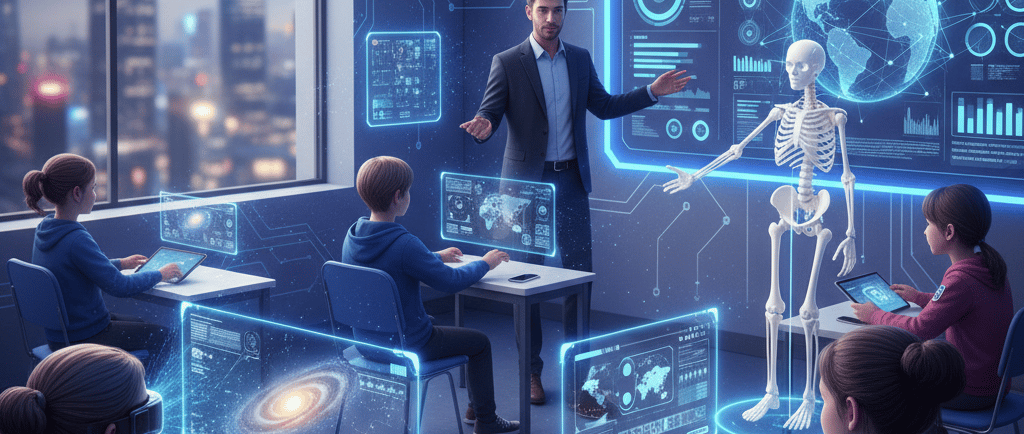

Think of sitting in a classroom and getting a chance to pull the toe of a robot frog, spending time at the computer looking at ancient Roman buildings, or even assembling a complicated engine with the press of a few buttons. This is not a part of a futuristic movie, and this is what augmented reality (AR) applications are doing to the educational process in 2025. With technology ever-transforming at a high rate, AR is becoming an influential tool, and it is changing the way students learn and the way teachers teach. This virtual reality technology is an overlay of digital data onto the real environment, forming interactive and engaging experiences that are more impressive than simple textbooks and lectures. Any tech enthusiast, educator, or any other person with an interest in the future of learning has to know how augmented reality can influence education.
Key Takeaways
AR changes learning: Augmented reality transforms passive learning into interactive experiences that are engaging, and learners find complex topics to be easier to absorb.
Instant 3D Interactions: AR applications enable pupils to experience 3D models of anything, including human organs or artefacts produced in history, and increase their understanding and memorization.
Broad Usability on Topics: AR not only improves science by dissecting virtual organs, but also can increase knowledge on inquiries about ancient civilizations in history.
Difficulties and Remedies: There are expenses and technical obstacles, but continued innovation and available applications are leading to AR becoming possible in academic organisations.
Bright Future: Beyond those hardware and AI breakthroughs, AR is expected to continue becoming an even greater component in personalised and engaging educational patterns in 2025 and beyond.
What is Augmented Reality (AR)?
It would be wise to first define what augmented reality is before getting into the applications it has in education. In comparison to virtual reality (VR) that entirely engages users in a digital environment, AR works to suit the physical one with digital data by overlaying digital images, thus adding 3D models, video, or superimposed objects and features to an otherwise real-time perspective. You can remember the examples of such popular apps as Pokémon GO, where you can see the digital lives of creatures in your reality with the help of the smartphone camera. In teaching it involves making abstract things real so that students can communicate with digital information, like the case of touching something with a physical presence.
The beauty of AR is to be accessible. Although more expensive VR might use specialized equipment in the form of VR headsets, most AR apps can be executed on some devices that students and schools already have, e.g., smartphones, tablets, and, as explained in 2025, more advanced AR gloves may also appear on the market.
Read more: Gaming Laptop vs. Cloud Gaming: Which is Right for You in 2025?
Who cares about the Power of AR in Education? Why it should be important in 2025.
The conventional classroom is usually unable to engage the attention of learners who are used to effective, dynamic digital information. AR is a powerful solution that helps to bridge the gap between the theoretical and the practical realms. This is why the augmented reality in education is becoming highly popular:
1. Greater Involvement and Improvement.
Augmented reality helps to increase the engagement of students, which is one of the greatest benefits of this strategy in education. Students would feel motivated to take part whenever they participate in learning as an interactive process. They are not required to read about the solar system; rather, they are allowed to project a 3D model of the planets in their classroom and walk through them. Such a practical, inquisitive step will prove education to be enjoyable and easy to recall.
As it is said, AR makes the viewers active participants in the process, and education turns into a quest and a game, rather than homework.
2. Greater Understanding and Memorization.
The 3D views of complex concepts can greatly help with comprehension. In more practical subjects, such as biology, chemistry, or engineering, augmented reality apps enable students to handle models, see processes, and even dissect virtual items without any danger or a mess. Direct contact can consolidate the knowledge and enhance retained knowledge in the long term. Three-dimensional images of the beating heart or the arrangement of a molecule are much more informative, and a two-dimensional drawing can never replace these images.
3. Applicative and competency 101.
AR not only helps in theoretical studies, but it is also important in the acquisition of practical abilities. The augmented reality can be used in vocational training programs in order to create a simulation of the real world where students are able to practice a task such as repairing machinery, completing medical procedures, or even conducting virtual experiments. This gives one a secure and repeatable learning realm to master the skills and then put them into practice in an actual situation.
4. Availability and Non-discrimination.
AR is capable of supporting different learning styles. Kinesthetic learners are able to interact through interaction, whilst visual learners text to gain the advantages of a 3D model. AR can also be used as a potential solution for special-needs students and offer them alternative means to listen to and comprehend information. To give an example, an AR app may offer visual interactions or ease complicated instructions to make the learning settings more accommodating.
5. Individualised Learning Experience.
AR can be created in a way that can accommodate each student and his/her learning styles. These augmented reality applications can be used to provide customized challenges, extra resources, or various degrees of detail so that every student learns at their own pace and in a manner that is most helpful to them by tracking interactions. This is in contrast to the one-size-fits-all education methodology.
Read more: Unlocking the Future: How AI Works In Technology, Finance, and Healthcare. Guide to AI in 2025
The applications of Augmented Reality in Education: Practical Uses.
This is because the applications of augmented reality cut through virtually every field of subject. The current application of augmented reality in education in 2025 looks as follows:
Science and STEM Subjects 🔬
Anatomy & Biology: The students will be able to study the human body or the anatomy of an animal in 3D, layer by layer of the muscles, organs, and bones. Such applications as Complete Anatomy or Anatomy 4D can be used to study the anatomy in detail and engage.
Chemistry: Visualize chemical reactions, atomic models, and molecular structures. Learners can use relative (combined) elements and witness reactions taking place, and this enables them to make sense out of abstractions.
Physics: This field involves the illustration of such concepts as gravity, movement, and electromagnetism using interactive simulations that superimpose on the real world.
Astronomy: Use apps such as SkyView Lite or Star Walk 2 to view the position of constellations and planets, as well as satellites in the night sky, with a device.
History and Social Studies 🏛️
Ancient Civilizations: Students can visit some of the historical locations, such as the grand Roman Colosseum or Pompeii in Italy, and the ancient Egyptian pyramids, to travel and study the recreated surroundings.
Events in History: S recreate the key historical events and allow students to experience the actions in their classroom, which adds layers and surrounds them.
Geography: Use topographical maps, weather patterns, or demographics and overlay them on a physical map, which gives a dynamic perspective on information about the whole world.
Art and Design 🎨
3D Modelling: The 3D models allow students to build and activate 3D models in a real-world environment, which results in creativity and spatial thinking.
Virtual Galleries: Have a projection of famous artworks on the walls of the classroom or tour virtual exhibits at a museum and learn about the history of art.
The architectural design: Visualise Architecture Design. Visualise designs of architectural material in a real-world environment before building, which aids the students in comprehending scale and impact.
Language Learning 🗣️
Interactive Vocabulary: AR apps can overlay translations or definitions on objects in the real world, which gives students the opportunity to learn new words in context.
Cultural Immersion: Explore countries virtually and experience the digital parts using their native language, bringing together greater cultural awareness and language proficiency.
Professional Training and Skill Building 👷♀️
Medical Training: Do surgery (or diagnose virtually) patients.
Engineering: Combine complicated machinery or troubleshoot computer systems.
Maintenance & Repair: Have Trainers mark instructions on the equipment on how to repair it in stages.
Read more: Artificial Intelligence in Gaming vs Artificial Intelligence Art: Innovation and Play in 2025.
INSIGHTS
Your go-to source for latest tech gadgets news
Support
Connect
© 2025. Bit Wise Reviews
+91 6377810443
Quick Links